📚 Active ARCs
View all →

Socials
Latest Reviews
View all →| Book | Review | Offsite |
|---|---|---|
|
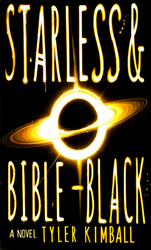
In an alternate universe where erudite people are rich, famous, and ruthless, I think Tyler Kimball would be studied in universities. He made me feel profoundly ignorant (and that's a good thing!). Starless and Bible-Black is a collection of interconnected stories set in the Starscape, the last planet at the end of time, built from the corpses of dead galaxies and populated by everything that survived the death of the universe. It's home to bored immortals, impossible aliens, diminished gods, corporate demons, and a crew of investigators trying to bring something resembling justice to a cosmos that no longer makes sense. Put like that, it sounds like prose on acid... and it actually is. The prose is lush to excess. Every paragraph overflows with neologisms, erudite references (from Byron to King Crimson, from Lovecraft to the Platters. And surely dozens more I didn't catch), and worldbuilding layered like a cake of cosmic information. A character doesn't simply enter a room: they cross impossible architectures laden with trillions of years of history while the narrator explains the biology of three alien races and the politics of five warring factions. Most of the time, it works. The story Dutch Pink that opens the collection is a small masterpiece of weird fiction: a man with divine blood who can be killed but reforms, enters the fortress of a Martian warlord to propose a "landscaping job." It's violent, sarcastic, and... damn, it's moving. The Scholar of Tragedies succeeds remarkably at rendering a non-human point of view. There are sections where encyclopedic worldbuilding buries the story under layers of invented terminology. The cast is so vast that even by the end some characters remain somewhat flat. When Kimball works, he works brilliantly. This is not a book for everyone. Damn, it makes you wonder the opposite: whether the reader is good enough for the book, not the other way around! I consider writing a craftsman's path. I hate talking about art; I find it pompous and self-centered. But with Starless, you can't talk about craft. This is truly a work of art. |
|

|
He knows how to cook
(4 )
By now, I’ve realized that I like Tyler Kimball. That Great Leviathan is the third of his works I have read and the guy has chops. He knows how to cook. Unlike his previous works, the historical-weird essay Whom Gods Would Destroy and the collection written on acid, Starless and Bible-Black, this is a full-fledged novel. Kingfisher Volganin is a harpy, not in some generic mythological sense, but a bird-woman with functional wings, prehensile talons, and an identity teetering between the human world and something far older. She arrives in Samyy Severnyy, a port city at the far northern edge of a world where dragons are local politicians, alchemists run industries, and sylphs are bored weapons of mass destruction. Twenty-two centuries of slaughter would bore anyone. She travels with a group of postgrad students: Fade, Lund, Mageirissa, known as The Bastards’ Gang. The name fits. The plot revolves around a political intrigue involving the city’s dragon-mayor, a queen with temporal powers, a gnome from the secret police, a dead arms dealer, and a legendary sylph freshly freed from her arboreal prison. Now that I think about it, this book probably was written on acid too. There are dragon-killing cannons, automata with mercury hearts, and a Leviathan sleeping beneath the frozen sea. It is all dense, very dense. Kimball does not hold the reader by the hand. He does not explain what the echeneis, the Boazovazzi, the Pilgrims of the Furnace, the Four Cardinalities, or many other things are, things I cannot remember off the top of my head. When it works, and it often does, the result is total immersion. When it does not, it becomes a terminological swamp that risks losing the reader along the way. Some readers like being treated like adults, some want to be spoon-fed. Everyone knows what kind of reader they are. Kingfisher is an iconic figure. She wants to be a legendary hero but cannot quite fly straight. She has the courage to face a dragon yet cries when she loses feathers. Her relationship with Fade is the most human element in the book. There are flaws. Pacing, especially. The first chapters are setup, and while they are rich in texture and worldbuilding, the real plot starts much later. The central political section drags with too many factions, meetings, and names. It is fine to be treated like adults, but here it feels like being asked to form a government without even knowing the candidates’ names. The climax, while spectacular, is so chaotic that it is occasionally confusing. The prose is classic Kimball, showing he knows where to get the good stuff. Learned, layered, full of naturalistic erudition and oblique references. The kind of prose that makes you feel ignorant in a good way. It is a book that rewards perseverance and obviously not for everyone. If the word gaslamp makes your eyes light up, there is a world in here that deserves your time. |
|
|
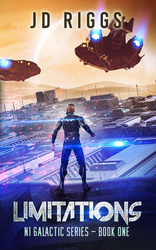
Limitations is a novel that earns affection despite its flaws. The real strength here is atmosphere. The protagonist falling in love with J-27, the tech markets, dinners with colleagues, artificial sunsets, there's a warmth reminiscent of travel memoirs that makes this world feel lived-in. You can tell the author loves this universe and wants you to love it too. Where the book struggles is pacing and conflict structure. The first half moves slowly, almost contemplatively, then the political thriller crashes in during the final chapters without room to breathe. The protagonist experiences events more than he drives them, which undercuts tension. A note on the prose: some constructions suggest English may not be the author's first language. If that's the case... Whoa! The achievement here is admirable! writing an entire novel in a non-native language takes real courage. A light editing pass, even just at the line-editing level, would smooth out the rough edges and let the ideas shine through more clearly. This is a debut that shows genuine passion. Riggs has stories to tell and an interesting world to tell them in. |